




Hurst Exponent - Detrended Fluctuation Analysis
October 13, 2022, 1:17 PM
Indicators
2 Comments
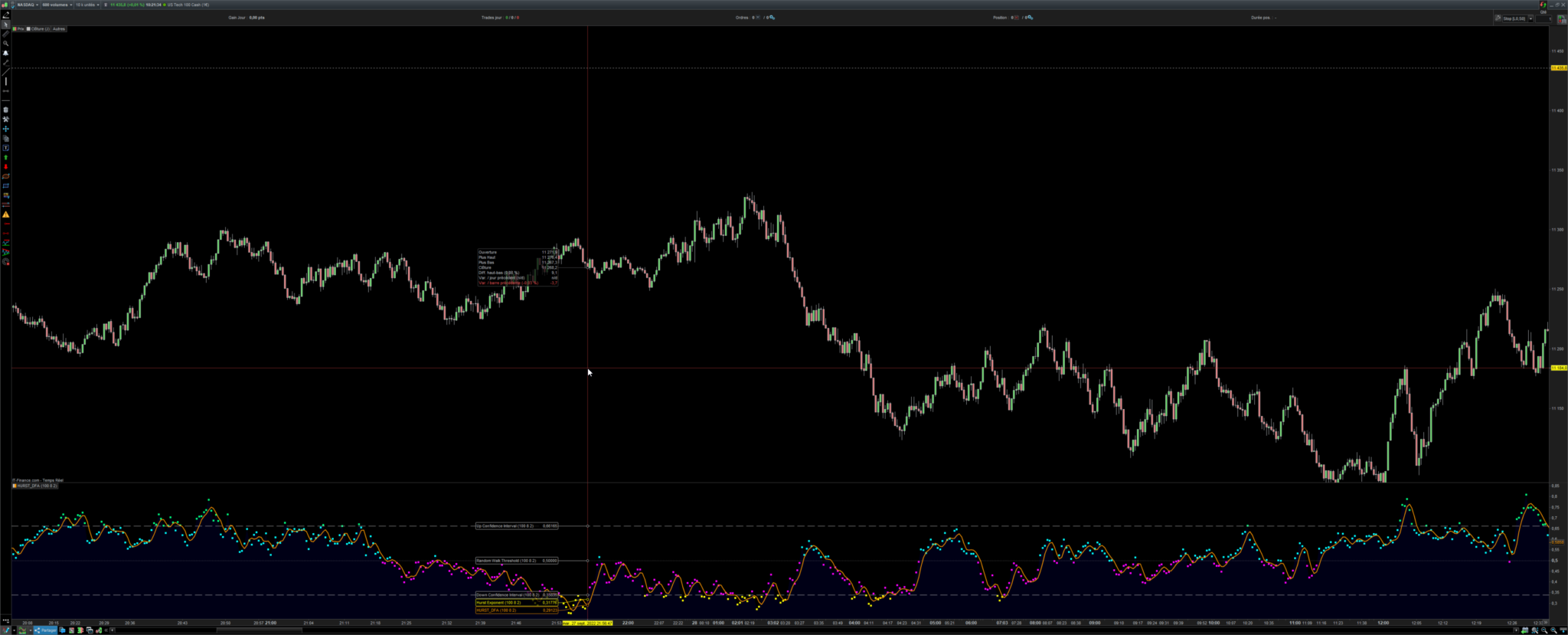
This is the port to PRT of the nice balipour indicator from tradingview.
In stochastic processes, chaos theory and time series analysis, detrended fluctuation analysis (DFA) is a method for determining the statistical self-affinity of a signal. It is useful for analyzing time series that appear to be long-memory processes and noise.
WARNING : this indicator will hit your CPU very hard. It was a test drive for me to test the limit of ProBuilder. I don’t recommend using it in real time.
For practical and intuitive indicators, you can have a look at my ProRealCode Market store.
//defparam calculateonlastbars = 2000

// Params
 len: 100
 bsc: 8
 msc: 2

//Log Return
r = log(close / close[1])

//Mean of Log Return
mean = average[len](r)

//Cumulative Sum
sum = 0
for i = 0 to len - 1 do
sum = (r[i] - mean) + sum
$csum[i] = sum
next

// Approximating log scale function (save sample size)
for i = 0 to 9 do
$fs[i] = round(bsc*pow(pow(len/(msc*bsc),0.1111111111),i))
next

for i = 0 to 9 do
//Average of Root Mean Sum Measured each block (Log Scale) ARMS
bar = $fs[i]
num = floor(len / bar)
sumr = 0
for j = 0 to num - 1 do
//Root Mean Sum (FLuctuation) function linear trend to calculate error between linear trend and cumulative sum
rms = 0
count = 0
N1 = j * bar
N  = bar

//Slicing the array into different segments
for k = 0 to N - 1 do
count = count + 1
$seq[k] = count
next

for k = N1 to N1 + N - 1 do
$y[k - N1] = $csum[k]
next

//Linear regression measuing trend (N/(N-1) for sample unbiased adjustedment)
ec = 0
for k = 0 to N - 1 do
ec = ec + $seq[k]
next
mc = ec / N

varx = 0
for k = 0 to N - 1 do
varx = varx + square($seq[k] - mc)
next
sdx = sqrt(varx/N) * sqrt(N/(N-1))

ey = 0
for k = 0 to N - 1 do
ey = ey + $y[k]
next
my = ey / N

vary = 0
for k = 0 to N - 1 do
vary = vary + square($y[k] - my)
next
sdy = sqrt(vary/N) * sqrt(N/(N-1))

esy = 0
for k = 0 to N - 1 do
esy = esy + $seq[k] * $y[k]
next
msy = esy / N

cov = (msy - mc * my) * (N/(N-1))

rr2 = pow(cov/(sdx*sdy), 2)
rms = sqrt(1 - rr2) * sdy

sumr = sumr + rms
next

$fluc[i] = log(sumr / num) / log(10)
next

//Set Ten Points of data scale along the X log axis
for i = 0 to 9 do
$scl[i] = log($fs[i]) / log(10)
next

// Slope Measured from RMS and scale on log log plot using linear regression
ssc = 0
for i = 0 to 9 do
ssc = ssc + $scl[i]
next
esc = ssc / 10

sfl = 0
for i = 0 to 9 do
sfl = sfl + $fluc[i]
next
efl = sfl / 10

sf = 0
for i = 0 to 9 do
sf = sf + ($scl[i] - esc) * ($fluc[i] - efl)
next
cov = sf / 10

ssq = 0
for i = 0 to 9 do
ssq = ssq + square($scl[i] - esc)
next
var = ssq / 10

hurst = cov / var

//Critical Value based on Confidence Interval (95% Confidence)
ci = 1.645 * (0.3912 / pow(len,0.3))
//Expected Value plus Crtical Value
cu = 0.5 + ci
cd = 0.5 - ci

if hurst > cu then
hr = 0
hg = 255
hb = 128
elsif hurst >= 0.5 then
hr = 0
hg = 255
hb = 255
elsif hurst < cd then
hr = 255
hg = 255
hb = 0
elsif hurst < 0.5 then
hr = 255
hg = 0
hb = 255
endif

smooth = (hurst + 2 * hurst[1] + 2 * hurst[2] + hurst[3]) / 6

return hurst coloured(hr, hg, hb) style(point, 3) as "Hurst Exponent", cu as "Up Confidence Interval", cd as "Down Confidence Interval", 0.5 as "Random Walk Threshold", smooth
Download
Filename:
HurstExp–DetrendedFluctAnalys.itf
Downloads:
100
Senior
https://market.prorealcode.com/store/digital-filters-workshop/
Author’s Profile


Loading...