G-Channels – Efficient Calculation Of Upper/Lower Extremities
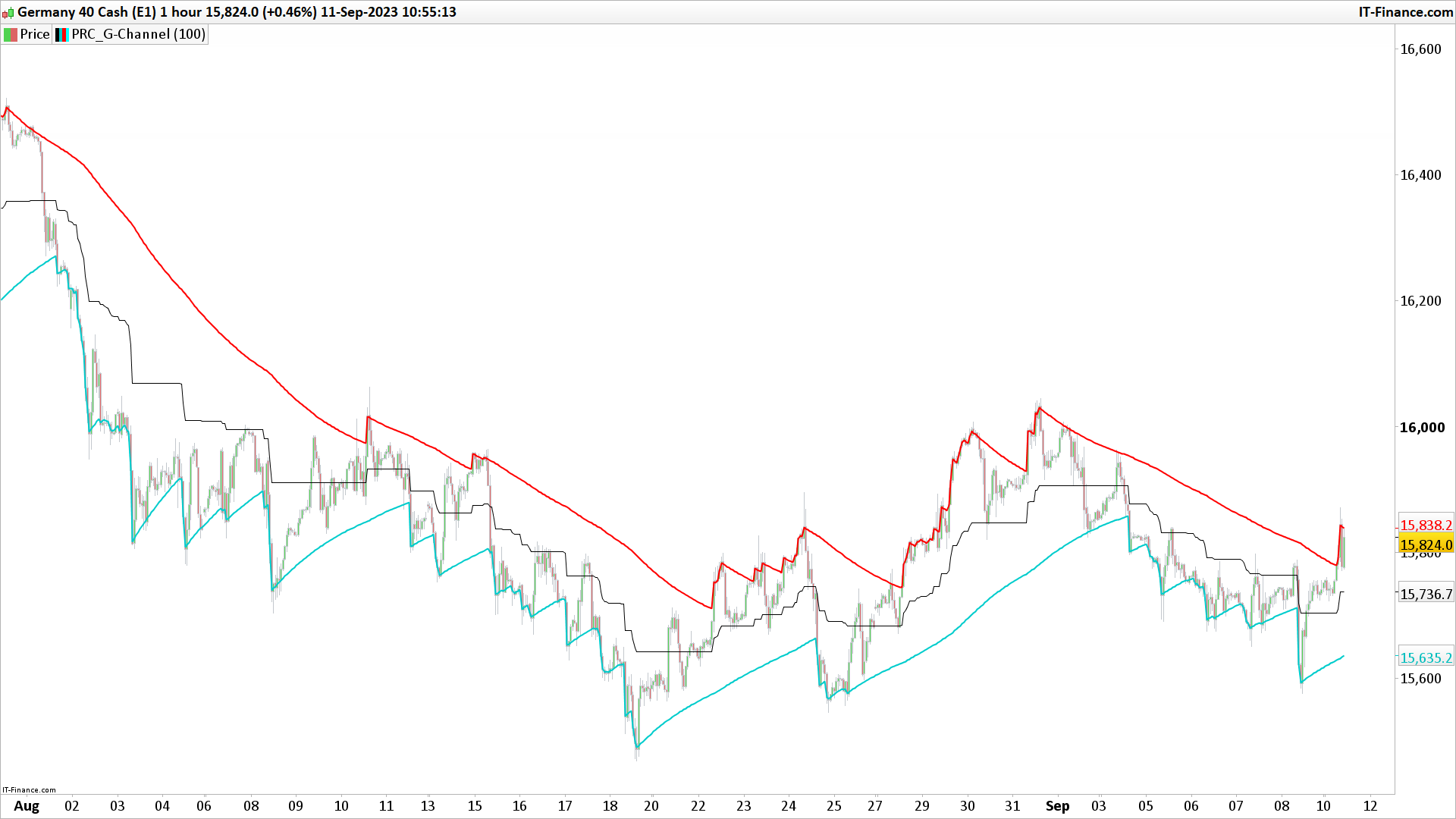
G-Channels – Efficient Calculation Of Upper/Lower Extremities

Channels indicators are widely used in technical analysis, they provide lot of information. In general, technical indicators giving upper/lower extremities are calculated by adding/subtracting a volatility component to a central tendency estimator. This is the case with Bollinger bands, using the rolling standard deviation as volatility estimator and the simple moving average as central tendency estimator, or the Keltner channels using the exponential moving average and the average true range.

Lots and lots and lots of those indicators have been made, they only really need a central tendency estimator, which can be obtained from pretty much any filter, however i find interesting to focus on the efficiency of those indicators, therefore i propose a super efficient channel indicator using recursion. The average resulting from the upper/lower extremity of the indicator provide a new efficient filter similar to the average highest/lowest.

The calculation – How Does It Works:

Efficiency is often associated to recursion, this would allow us to use past output values as input, so how does the indicator is calculated? Lets look at the upper band calculation :

a = max(src,(a[1])) – (a[1] – b[1])/length

src is the closing price, a is upper extremity, b is the lower one. Here we only need 3 values, the previous values of a and b and the closing price. Basically a = max(src,a[1]) mean :

if the closing price is greater than the precedent value of a then output the closing price, else output the precedent value of a

therefore a will never be inferior to its precedent value, this is useful for getting the maximum price value in our dataset however its not useful to make an upper band, therefore we subtract this to a correction factor defined as the difference between a and b, this force the upper band to have lower values thus acting like a band without loosing its “upper” property, a similar process is done with the lower band.

Of course we could only use 2 values for making the indicator, thus ending with :

a = max(src,a[1]) – (abs(close – a[1])/length

(description from original author: alexgrover)

Share this

Risk disclosure:

No information on this site is investment advice or a solicitation to buy or sell any financial instrument. Past performance is not indicative of future results. Trading may expose you to risk of loss greater than your deposits and is only suitable for experienced investors who have sufficient financial means to bear such risk.

ProRealTime ITF files and other attachments : How to import ITF files into ProRealTime platform?

PRC is also on YouTube, subscribe to our channel for exclusive content and tutorials

  1. Alai-n • 09/11/2023 #

    I really like it when you develop ideas around price movement! I am much less a fan of all the indicators calculated with averages of this or that, too subjective in my opinion!

avatar
Register or

Likes

avatar avatar avatar avatar avatar avatar avatar avatar avatar
Related users ' posts
MaoRai54 Thanks, now it's OK. in your first code at line 15-16 it's missing.
Madrosat Hello Ivan Did you try a strategy with this indicator
Iván Hi. No I didn't. This is a code translation requested by an user a few days ago.
Iván
2 years ago
cjr30 Simplemente modifica las lineas 19 y 21 por las siguientes: drawtext("▲",barindex,low-0.1*a...
groelandes Gracias!!
WhyAskOZ i copied the code into strategy and it gives error on line 21 and 23. it says " Line 1: ...
Iván
2 years ago
Madrosat Hello Ivan You have interesting topics on indicators , smart supertrend, optimised trend t...
Iván Hi! thanks. All of these codes are translations requested in the forum. I've on mind to back...
Raspete01 Buenos días Iván, estoy intentando llevar el código eliminando los colores y pasando un Back...
jacquesgermain sì da aggiungere
Maik2404 auf welchen Wert muss ich die Kompresionsperiode stellen?
jacquesgermain — Période de compression : ce paramètre détermine la période de rétrospection utilisée pour ...
Iván
2 years ago
winnie37 Hi Ivan, if i want to use it, and call the oscillator value (in grey, green or red), how to...
Iván The oscillator is smoothtype. In inputs there is de lag to configure the output
ARLEQUIN49 Hello Ivan, Would it be possible to convert the code of this QQE MOD indicator which accomp...
ARLEQUIN49 here is the code: //@version=4 //By Glaz, Modified // study("QQE MOD") RSI_Period = i...
Iván Hi, Yes I can translate it but please, create a new topic for it.
Fgats quelques explications en Français ici : Some explanations in French here : https://www.p...
Nicolas Merci pour cette contribution, j'apprécie ! :)
Fgats Merci Nicolas pour ces encouragements et merci aussi pour le commentaire en Anglais accompa...
luxrun A question: what are the initial (or default) values ​​of maximum and minimum in the executi...
Quino
2 years ago
elcortijoverde Muy buen trabajo.Intuitivo y claro.Gracias por tu dedicación y aportación.
Nicolas
2 years ago
B-Xtrender
B-Xtrender
8
Indicators
616248 Bonjour Nicolas, Peux tu nous expliquer le principe de fonctionnement ? Ou nous mettre un...
Nicolas Le lien vers l'article IFTA de l'auteur est dans le post déjà :)
P. Marlowe Very poweful indeed. It deserves close attention. I really appreciate very much IFTA backgro...
JS
2 years ago
Trendilo
Trendilo
1
Indicators
Coded1 very interesting indicator, thanks JS
Nicolas
2 years ago
Lucas0000 Hello, Congratulations on this programming, it seems incredible to me, I am new to this but ...
plbourse Hello, I am trying to use this singal (in fact I have converted it to an indicateur giving B...
manfeber Buenos dias,alguien me podria decir como se descargar el archivo o el indicador Q-Trend??,ya...
BriceE Bonjour Nicolas, Je suis a la recherche d'indicateurs pour me donner la meilleure indicatio...
Nicolas
3 years ago
Maxime Baudin Well done Nicolas, creative!
Stenozar Hi Nicolas, please can you explain how to read/use this indicator? thanks!
mortezaali14 Salut Nicholas, comment exécuter ce fichier dans les métadonnées
Leduc71 Bravo ! Cet indicateur est un suiveur de tendance, type “stop and reverse”, inspiré des cana...
Carburo Bonjour Leduc71, j'ai l'impression qu'il y a des erreurs dans la première ligne de code qui ...
Nicolas Yes, Magic if the variable that contains the value of the line, you can test if it goes up o...
dadah1987 Bonjour Nicolas, merci pour cet indicateur. Utilisant pour l'instant la création simplifié p...
Nicolas Merci d'ouvrir un sujet sur le forum avec une description complète du système.
GustavoLoboOrenstein Is it possible to add histogram with only increasing bars?
YvesRobert Bonjour Nicolas, en effet ca marche, je me suis trompé, j'ai bien tout le tracé. C'est parce...
oliTR Bonjour, les conditions longCond et shortCond ne contiennent-elles pas une condition qui s'a...
xpe74 Utilitaire vraiment top, d'autant qu'ajouter des filtres de seuil peux aider a limiter le no...

Top