




More from ProRealCode
ProRealCode - Trading & Coding with ProRealTime™



AutoLength Moving Average Indicator
Introduction
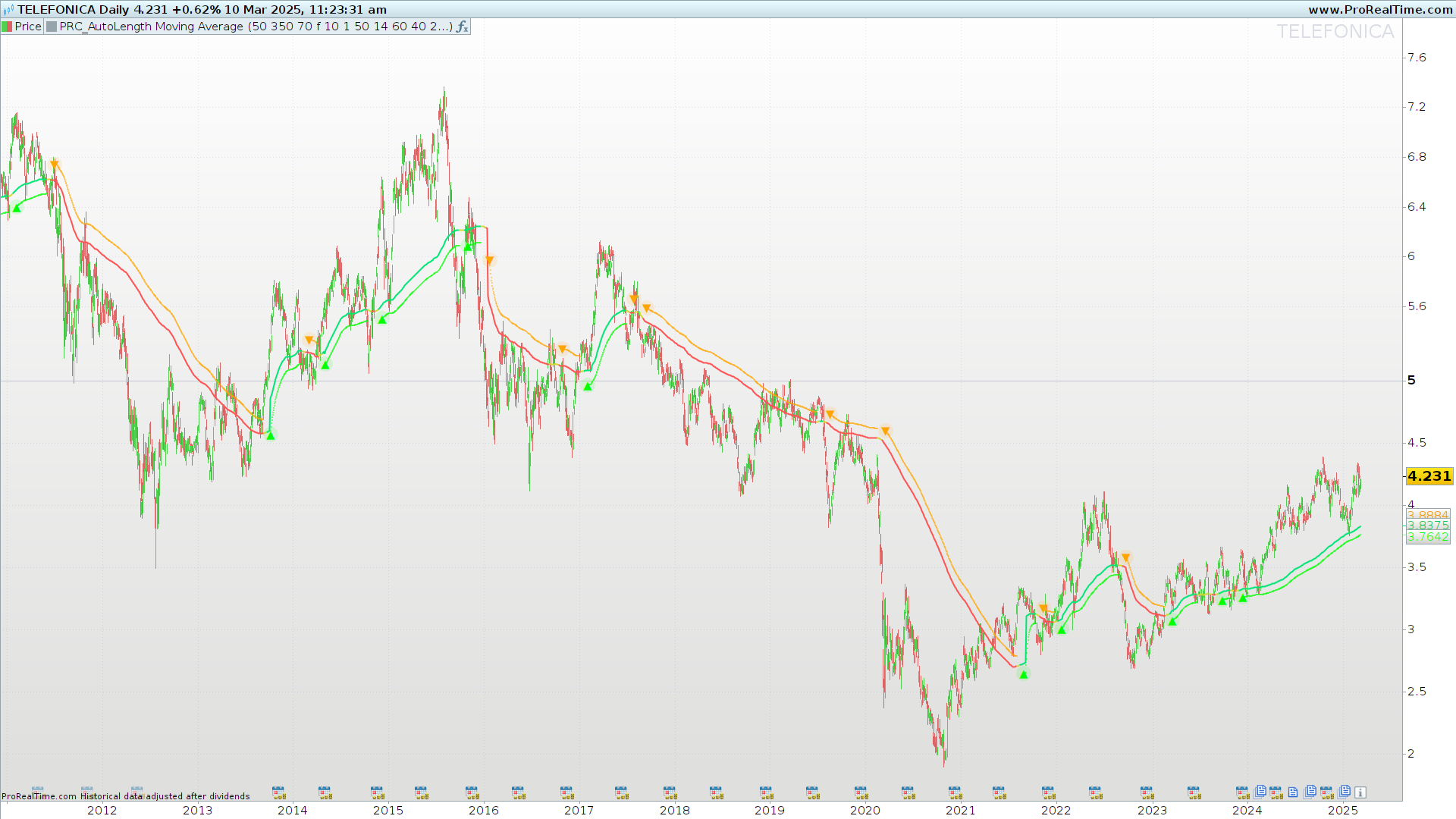
The AutoLength Moving Average is a dynamic adaptation of the traditional moving average that adjusts its length based on market conditions (author Zeiierman). Unlike standard moving averages that rely on fixed periods, this indicator intelligently modifies its length using a counter-based approach, allowing it to adapt to varying market trends. This feature makes it especially useful for traders who need a responsive yet smooth trend-following tool.
Concept and Functionality
The AutoLength Moving Average is designed to dynamically adjust its smoothing period, ensuring that it reacts appropriately to market fluctuations. Here’s how it works:
- It starts with a base length for the moving average.
- A counter tracks market conditions and increases or resets based on predefined reset conditions.
- The length of the moving average dynamically extends based on the counter’s value, up to a maximum limit.
- This results in a moving average that expands during strong trends and contracts during periods of uncertainty, optimizing its responsiveness to price action.
Key Components
- Dynamic Length Calculation: The moving average length expands progressively up to a maximum dynamic length, depending on market conditions.
- Counter Mechanism: A counter increases or resets based on the chosen reset condition, affecting the adaptive length of the moving average.
- Trend Detection: The indicator determines trend direction by analyzing moving average crosses and confirming trends over a given period.
This approach allows the AutoLength Moving Average to smooth price movements while being flexible enough to capture changes in trend direction efficiently.
Reset Conditions
A critical aspect of this indicator is its ability to reset or reverse the counter based on different market conditions. The trader can select from eight different reset conditions:
- Moving Average Slope: The counter resets when the slope of the moving average changes direction.
- RSI Overbought/Oversold: A reset occurs when the RSI exceeds overbought or drops below oversold levels.
- Volume SMA: The counter resets when the volume exceeds its moving average, indicating an increase in trading activity.
- Bollinger Bands Breakout: A reset happens when the price crosses above or below the Bollinger Bands.
- MACD Crossover: The reset is triggered when the MACD line crosses above or below the signal line.
- Stochastic Overbought/Oversold: A reset occurs based on the stochastic oscillator exceeding thresholds.
- CCI Overbought/Oversold: The Commodity Channel Index is used to detect extreme market conditions.
- Momentum (Rate of Change): The counter resets when the rate of change of price momentum turns positive or negative.
By selecting the appropriate reset condition, traders can fine-tune the indicator to align with their trading style, whether they prefer trend-following or mean-reversion strategies.
Visualization and Signals
To enhance usability, the AutoLength Moving Average includes visual elements to indicate key trading signals:
- Trend Confirmation:
- A strong uptrend is confirmed when the indicator detects a consistent upward trend over a defined period.
- A downtrend is confirmed similarly for downward movements.
- Trend Color Coding:
- Green (Confirmed Uptrend): When the uptrend is validated.
- Red (Confirmed Downtrend): When the downtrend is validated.
- Yellow (Uncertain Trend): If the trend is not confirmed.
- Reversal Signals:
- An orange marker appears when an uptrend starts.
- A lime marker appears when a downtrend starts.
These signals help traders quickly identify trend shifts and adjust their strategies accordingly.
Configuration and Customization
To optimize the indicator for different market conditions, traders can adjust several parameters:
Primary Inputs:
- Base Length (Default: 50): Initial period for the moving average.
- Max Dynamic Length (Default: 350): The maximum expansion allowed for the adaptive length.
- Counter Threshold (Default: 70): The limit before the counter stops increasing.
- Reverse Counter (Default: False): Enables or disables counter reversal after reaching the threshold.
- Trending Confirmation (Default: 10): The number of periods required to confirm a trend.
Reset Condition Settings:
- RSI Length, Overbought & Oversold Levels
- Volume SMA Length
- Bollinger Bands Length & Multiplier
- MACD Fast, Slow & Signal Periods
- Stochastic Length, Overbought & Oversold Levels
- CCI Length, Overbought & Oversold Levels
- Momentum Length
Each of these settings allows users to adapt the AutoLength Moving Average to their preferred trading methodology.
ProBuilder Code Implementation
Below is the full ProBuilder code for the AutoLength Moving Average, which can be copied and used directly in ProRealTime:
//---------------------------------------------//
//PRC_AutoLength Moving Average (Zeiierman)
//version = 0
//10.03.2025
//Iván González @ www.prorealcode.com
//Sharing ProRealTime knowledge
//---------------------------------------------//
// Inputs
//---------------------------------------------//
src = close // Source price used for calculations
baseLen = 50 // Base length for the Moving Average
maxDynLen = 350 // Maximum dynamic length for MA
counterbreak = 70 // Threshold for counter reversal
reverseCounter = 0 // 1=true, 0=false -> Reverses counter after break
trendingCol = 10 // Length of trend confirmation
// Selection of Reset Condition Type
resetConditiontype = 1
// 1 = Based on Moving Average Slope
// 2 = Based on RSI Overbought/Oversold levels
// 3 = Based on Volume SMA
// 4 = Based on Bollinger Bands (Price Breakout)
// 5 = Based on MACD Line and Signal Line Crossover
// 6 = Based on Stochastic Overbought/Oversold levels
// 7 = Based on CCI Overbought/Oversold levels
// 8 = Based on Momentum (Rate of Change)
// Ma
slopeOB = 50 // Length for MA slope calculation
//RSI
rsiLength = 14 // RSI period length
rsiOB = 60 // RSI Overbought level
rsiOS = 40 // RSI Oversold level
//Volume
volSmaLength = 20 // Volume SMA length
//Bollinger
bblength = 200 // Bollinger Bands length
bbMult = 1.1 // Bollinger Bands multiplier
//Macd
macdfastLength = 50 // Fast length for MACD calculation
macdSlowLength = 100 // Slow length for MACD calculation
macdSignalLength = 25 // Signal length for MACD
//Stochastic
stochLength = 50 // Stochastic period length
stochOB = 60 // Stochastic Overbought level
stochOS = 40 // Stochastic Oversold level
//CCI
cciLength = 100 // Commodity Channel Index (CCI) length
cciOB = 10 // CCI Overbought threshold
cciOS = -10 // CCI Oversold threshold
//Momentum
momentumLength = 140 // Momentum period length
//Trend
length = 20 // Trend smoothing length
trendSmoothing = 0.8 // Smoothing weight for trend adaptation
trending = 20 // Trending periods for confirmation
//---------------------------------------------//
// Calculate indicators
//---------------------------------------------//
// RSI
rsivalue=rsi[rsilength](src)
// Volume SMA
volSMA = average[volSmaLength,2](volume)
// MACD
mymacdline=MACDline[macdfastLength,macdSlowLength,macdSignalLength](src)
mysignalline=MACDSignal[macdfastLength,macdSlowLength,macdSignalLength](src)
// Stochastic
stochK=Stochastic[stochLength,3](close)
// CCI
ccivalue=cci[cciLength](src)
// Momentum (rate of change)
mymomentum=roc[momentumLength](src)
// Bollinger bands
basisBB=average[bblength](src)
bbStd=std[bblength](src)
bbupper=basisBB+bbMult*bbStd
bblower=basisBB-bbMult*bbStd
//---------------------------------------------//
// Dynamic MA and counter variables
//---------------------------------------------//
once counter=1
once prevState=0

dynLen=min(baseLen+(counter-1),maxDynLen)
ma=average[dynLen](src)

//---------------------------------------------//
// Get the current condition state
//---------------------------------------------//
once state=0

if resetConditiontype=1 then
if ma>ma[slopeOB] then
state=1
elsif ma<ma[slopeOB] then
state=-1
else
state=0
endif
elsif resetConditiontype=2 then
if rsiValue>rsiOB then
state=1
elsif rsiValue<rsiOS then
state=-1
else
state=0
endif
elsif resetConditiontype=3 then
if average[20](volume)>volSMA then
state=1
elsif average[20](volume)<volSMA then
state=-1
else
state=0
endif
elsif resetConditiontype=4 then
if close>bbupper then
state=1
elsif close<bblower then
state=-1
else
state=0
endif
elsif resetConditiontype=5 then
if mymacdline>mysignalline then
state=1
elsif mymacdline<mysignalline then
state=-1
else
state=0
endif
elsif resetConditiontype=6 then
if stochk>stochOB then
state=1
elsif stochk<stochOS then
state=-1
else
state=0
endif
elsif resetConditiontype=7 then
if ccivalue>cciOB then
state=1
elsif ccivalue<cciOS then
state=-1
else
state=0
endif
elsif resetConditiontype=8 then
if mymomentum>0 then
state=1
elsif mymomentum<0 then
state=-1
else
state=0
endif
endif

currentState = state

//---------------------------------------------//
// Update the counter with reverse counting option
//---------------------------------------------//
once counterIncreasing=1

if currentState<>0 then
if currentState<>prevState then
counter=1
counterIncreasing=1
else
if reverseCounter then
if counterIncreasing then
if counter<counterbreak then
counter=1+counter
else
counterIncreasing=0
counter=counter-1
endif
else
if counter>1 then
counter=counter-1
else
counterIncreasing=1
counter=1+counter
endif
endif
else
counter=1+counter
endif
endif
else
counter=1
counterIncreasing=1
endif
prevState=currentState

//---------------------------------------------//
// Recalculate th dynamic MA based on the updated counter
//---------------------------------------------//
dynLen=min(baseLen+(counter-1),maxDynLen)
ma=average[dynLen](src)

//---------------------------------------------//
// Trend Direction
//---------------------------------------------//
once trend=0
if close crosses over ma then
trend=1
elsif close crosses under ma then
trend =0
endif
trendChange=trend<>trend[1]

//---------------------------------------------//
// Adaptative Trend calculations
//---------------------------------------------//
atrThreshold=averagetruerange[200](close)
freq=2*3.1416/length
smoothfactor=trendSmoothing*freq
responseFactor=exp(-smoothfactor)

if barindex<counter+baseLen then
primaryFilter=0
secondaryFilter=0
else
primaryFilter=primaryfilter[1]+smoothFactor*(ma-primaryFilter[1])
secondaryFilter=secondaryfilter[1]*responseFactor+(1-responseFactor)*primaryfilter
endif

filteredTrend=(primaryFilter+secondaryFilter)/2
//---------------------------------------------//
// Track Trend stregth changes
//---------------------------------------------//
once trendUp=0
once trendDown=0

isUptrend=filteredTrend>filteredTrend[2]
isDownTrend=filteredTrend<filteredTrend[2]

//reset trend counters when direction changes
if isUptrend then
trendUp=trendUp+1
trendDown=0
elsif isDowntrend then
trendUp=0
trendDown=trendDown+1
endif
//---------------------------------------------//
// Colours and Signals
//---------------------------------------------//
ConfirmedUptrend=trendDown>=trending
ConfirmedDownTrend=trendUp>=trending

ConfirmedUptrendCol=trendUp>=trendingCol
ConfirmedDowntrendCol=trenddown>=trendingCol

PosTrendStart=ConfirmedUptrend and ConfirmedUptrend[1]=0
NegTrendStart=ConfirmedDownTrend and ConfirmedDownTrend[1]=0

circleUp=filteredTrend+atrThreshold
circleDn=filteredTrend-atrThreshold

if ConfirmedUptrendCol then
r=0
g=230
b=118
elsif ConfirmedDowntrendCol then
r=255
g=82
b=82
else
r=212
g=218
b=44
alphaDn=0
alphaUp=0
endif

if PosTrendStart then
drawtext("▼",barindex,circleUp)coloured("orange",255)
drawpoint(barindex,circleUp,5)coloured("orange",30)
alphaDn=0
alphaUp=125
elsif NegTrendStart then
drawtext("▲",barindex,circleDn)coloured("lime",255)
drawpoint(barindex,circleDn,5)coloured("lime",30)
alphaDn=125
alphaUp=0
endif

//---------------------------------------------//
return ma as "Dynamic MA" coloured(r,g,b)style(line,2), circleUp style(point,2)coloured("orange",alphaUp), circleDn style(point,2)coloured("Lime",alphaDn)
Conclusion
The AutoLength Moving Average is a powerful and flexible moving average designed for traders who require dynamic adaptation to market conditions. With its intelligent counter-based length adjustment and customizable reset conditions, it provides an edge over traditional moving averages by offering both smoothness and responsiveness.
This indicator is especially beneficial for trend traders, swing traders, and those who prefer adaptive technical analysis tools to improve their decision-making process.