







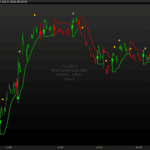
Adaptive ATR-ADX Trend
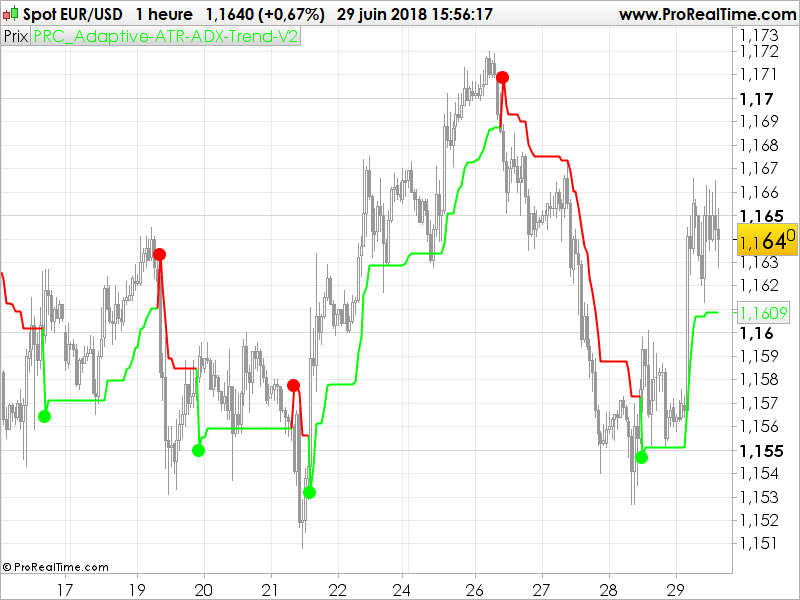
Constructs the trailing ATR stop above or below the price, and switches
directions when the source price breaks the ATR stop. Uses the Average
Directional Index ( ADX ) to switch between ATR multipliers. The higher
multiplier is used when the ADX is rising, and the lower ATR multiplier
is used with the ADX is falling. This ADX criteria further widens the gap
between the source price and the trailing ATR stop when the price is trending,
and lessens the gap between the ATR and the price when then price is not
trending.
The ATR-ADX stop is effectively a double adapative stop that trails the price,
by both adapting to the true range of the price, and the average directional
change. When the stop is below the price (long trade) the value never decreases
until the price intersects the stop, and it reverses to being above the price
(short trade). When the stop is above the price it will never increase until
it is intersected by the price. As the true range and ADX change, the stop
will move more quickly or more slowly.
First, if the ‘Above Threshold’ box is checked,the falling (smaller) multiplier
will be used regardless once the ADX rises above a certain threshold (default > 30).
The ATR will effectively rise faster once the price enters ‘very trendy’ mode.
Typically, ADX > 20/25 is used in classic ADX trading (which I have found
unprofitable through backtesting). The idea behind this extra multiplier criteria
is that once the price starts trending ‘very’ well, a top/bottom is likely near,
and when that top comes the price will quickly rebound. Experienced traders know
exactly what I am describing. Play around with an ADX/DI indicator using this
stop system in tandem and it will be found that many successful trades are entered
when the market is not trending (i.e. < ADX < 25), and exited once/if the price
enters ‘very trendy’ mode above 30 and the ATR changes (stopped out).
Second, heiken-ashi bars can be introduced to the ATR stop system. This is the same
thing as just switching the chart to Heiken Ashi mode, but without having to change
the plotting type. I find this useful, so that things like pivot lines can be
preserved to their correct calculations, while the benefit of heiken ashi bars can
still be enjoyed. Be advised that with each tinkering that extends the life of the
ATR trend, the odds of that same trend changing near the top/bottom are reduced,
so as always there is a trade-off to maximize the time spend in a trade and nailing
a top or bottom.
Third, Different source prices can be used. I have found that HLC3 is best because
it keeps the price from being stopped out in very key areas, set as the default.
Fourth, alert conditions are introduced so that the trader can be warned when the
ATR-ADX changes. These can be used by right clicking the strategy and clicking
“Add Alert…”. Reference the bottom of the script for the names of the alert
conditions.
(original code and description from its author: mortdiggiddy, all credits goes to him).
Code translated from TradingView (pinescript) code by a request in the english forum.
//PRC_Adaptive-ATR-ADX-Trend-V2 | indicator
//29.06.2017
//Nicolas @ www.prorealcode.com
//Sharing ProRealTime knowledge
//translated from tradingview code

// --- settings
atrLen = 21
m1 = 3.5 //"ATR Multiplier - ADX Rising"
m2 = 1.75 //"ATR Multiplier - ADX Falling"
adxLen = 14
adxThresh = 30 //"ADX Threshold"
aboveThresh = 1 //true, title = "ADX Above Threshold uses ATR Falling Multiplier Even if Rising?")
useHeiken = 1 //(false, title = "Use Heiken-Ashi Bars (Source will be ohlc4)")
// --- end of settings

source = MedianPrice

// DI-Pos, DI-Neg, ADX

hR = high-high[1]
lR = -(low-low[1])

if hr>lr then
dmPos=max(hr,0)
else
dmPos=0
endif
if lr>hr then
dmNeg=max(lr,0)
else
dmNeg=0
endif

sTR = (sTR[1] - sTR[1]) / adxLen + tr

sDMPos = (sDMPos[1] - sDMPos[1]) / adxLen + dmPos
sDMNeg = (sDMNeg[1] - sDMNeg[1]) / adxLen + dmNeg

DIP = sDMPos / sTR * 100
DIN = sDMNeg / sTR * 100
DX = abs(DIP - DIN) / (DIP + DIN) * 100
aadx = average[adxLen](DX)

// Heiken-Ashi

if barindex<2 then
xClose = close
xOpen = open
else
xClose = TotalPrice
xOpen = (xOpen[1] + close[1]) / 2
endif
xHigh = max(high, max(xOpen, xClose))
xLow = min(low, min(xOpen, xClose))

// Trailing ATR

v1 = abs(xHigh - xClose[1])
v2 = abs(xLow - xClose[1])
v3 = xHigh - xLow

trueRange = max(v1, max(v2, v3))
if useHeiken then
atr = WilderAverage[atrLen](trueRange)
else
atr = AverageTrueRange[atrLen]
endif

if aadx>aadx[1] and (adx < adxThresh or not aboveThresh) then
m=m1
elsif aadx<aadx[1] or (adx > adxThresh and aboveThresh) then
m=m2
else
m = m[1]
endif

if DIP >= DIN then
mUp=m
else
mUp=m2
endif
if DIN >= DIP then
mDn=m
else
mDn=m2
endif

if useHeiken then
src=xClose
c=Xclose
t=(xHigh+xLow)/2
else
src=source
c=close
t=MedianPrice
endif

up = t - mUp * atr
dn = t + mDn * atr

if max(src[1], c[1]) > TUp[1] then
TUp = max(up,TUp[1])
else
TUp = up
endif

if min(src[1], c[1]) < TDown[1] then
TDown = min(dn, TDown[1])
else
TDown = dn
endif

//trend
if min(src,min(c,close))>TDown[1] then
trend=1
elsif max(src,max(c,close))<TUp[1] then
trend=-1
else
trend=trend[1]
endif

if trend=1 then
sstop=TUp
r=0
g=255
else
sstop=TDown
r=255
g=0
endif

if trend<>trend[1] then
drawtext("•",barindex,sstop,Dialog,Standard,30) coloured(r,g,0)
endif

return sstop coloured(r,g,0) style(line,2)
Comments
You must be logged in to post a comment.

Hello Nicolas. I really like this indicator which works well for my automated trading strategy when backtesting however, when I go live IG/PRT stops the Automated Trading strategy after the close of the first 5min candle. I've tried all sorts to rectify this but can't find a way forward. Any advice on how to 'Call' this indicator from the strategy code without causing it to stop would be hugely appreciated. Many thanks Alistair

Bonjour à tous, J'aime beaucoup cet indicateur et j'aimerais pouvoir l'utiliser sur la dernière version de prorealtime V12 avec l'option "Utiliser une autre pèriode" cad pouvoir, par exemple, visualiser l'indicateur en 3mn sur un graph 2mn. Quelqu'un pourrait-il m'aider ? Merci d'avance. Bonne journée. Fran6



Nicolas, Can you explain the numerator logic - e.g. Line 35 is (sTR[1] - sTR[1]) which would appear to be either null or zero.

Thx Nicolas! trying to test this indicator in an automated strategy but I'm becoming crazy because when I call the indicator and then simply Graph it in the chart result, there is a discrepency in the value of the indicator vs it's "called" version in the strategy. How is that possible? In the strategy I'm calling it via the command


Good morning and thank you Nicolas.