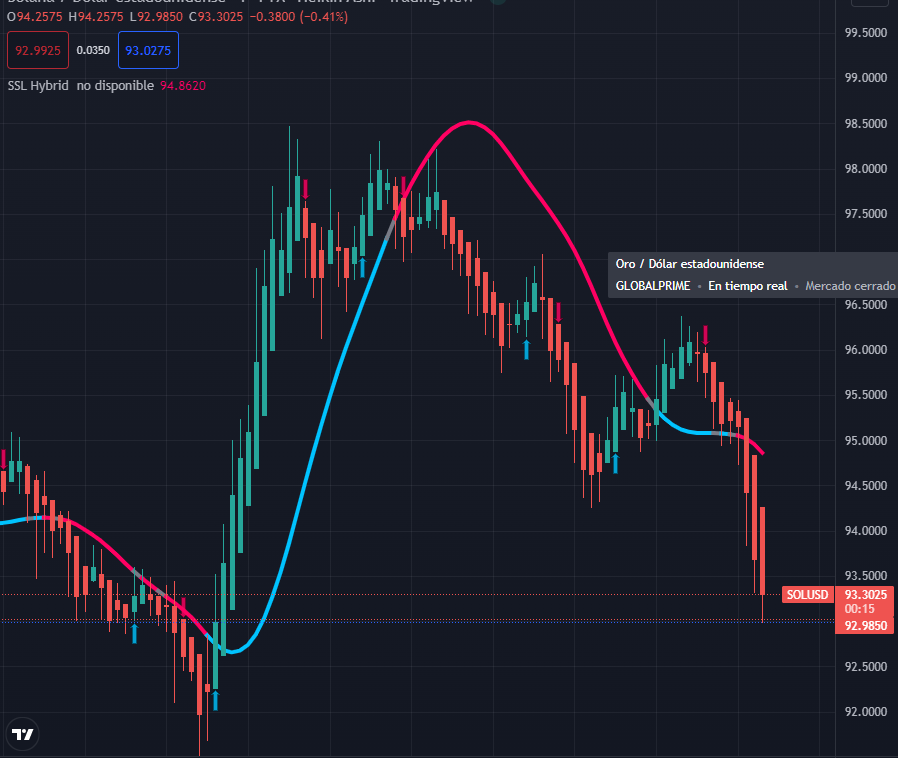
Hola os dejo aquí “parte” (porque aparece protegido) del código de un indicador de Tradingview llamado SSL HYBRID para su conversión a PRT. Graias
//@version=4
//By Mihkel00
// This script is designed for the NNFX Method, so it is recommended for Daily charts only.
// Tried to implement a few VP NNFX Rules
// This script has a SSL / Baseline (you can choose between the SSL or MA), a secondary SSL for continiuation trades and a third SSL for exit trades.
// Alerts added for Baseline entries, SSL2 continuations, Exits.
// Baseline has a Keltner Channel setting for “in zone” Gray Candles
// Added “Candle Size > 1 ATR” Diamonds from my old script with the criteria of being within Baseline ATR range.
// Credits
study(“SSL Hybrid”, overlay=true)
show_Baseline = input(title=”Show Baseline”, type=input.bool, defval=true)
show_SSL1 = input(title=”Show SSL1″, type=input.bool, defval=false)
show_atr = input(title=”Show ATR bands”, type=input.bool, defval=true)
//ATR
atrlen = input(14, “ATR Period”)
mult = input(1, “ATR Multi”, step=0.1)
smoothing = input(title=”ATR Smoothing”, defval=”WMA”, options=[“RMA”, “SMA”, “EMA”, “WMA”])
ma_function(source, atrlen) =>
if smoothing == “RMA”
rma(source, atrlen)
else
if smoothing == “SMA”
sma(source, atrlen)
else
if smoothing == “EMA”
ema(source, atrlen)
else
wma(source, atrlen)
atr_slen = ma_function(tr(true), atrlen)
////ATR Up/Low Bands
upper_band = atr_slen * mult + close
lower_band = close – atr_slen * mult
////BASELINE / SSL1 / SSL2 / EXIT MOVING AVERAGE VALUES
maType = input(title=”SSL1 / Baseline Type”, type=input.string, defval=”HMA”, options=[“SMA”,”EMA”,”DEMA”,”TEMA”,”LSMA”,”WMA”,”MF”,”VAMA”,”TMA”,”HMA”, “JMA”, “Kijun v2”, “EDSMA”,”McGinley”])
len = input(title=”SSL1 / Baseline Length”, defval=60)
SSL2Type = input(title=”SSL2 / Continuation Type”, type=input.string, defval=”JMA”, options=[“SMA”,”EMA”,”DEMA”,”TEMA”,”WMA”,”MF”,”VAMA”,”TMA”,”HMA”, “JMA”,”McGinley”])
len2 = input(title=”SSL 2 Length”, defval=5)
//
SSL3Type = input(title=”EXIT Type”, type=input.string, defval=”HMA”, options=[“DEMA”,”TEMA”,”LSMA”,”VAMA”,”TMA”,”HMA”,”JMA”, “Kijun v2”, “McGinley”, “MF”])
len3 = input(title=”EXIT Length”, defval=15)
src = input(title=”Source”, type=input.source, defval=close)
//
tema(src, len) =>
ema1 = ema(src, len)
ema2 = ema(ema1, len)
ema3 = ema(ema2, len)
(3 * ema1) – (3 * ema2) + ema3
kidiv = input(defval=1,maxval=4, title=”Kijun MOD Divider”)
jurik_phase = input(title=”* Jurik (JMA) Only – Phase”, type=input.integer, defval=3)
jurik_power = input(title=”* Jurik (JMA) Only – Power”, type=input.integer, defval=1)
volatility_lookback = input(10, title=”* Volatility Adjusted (VAMA) Only – Volatility lookback length”)
//MF
beta = input(0.8,minval=0,maxval=1,step=0.1, title=”Modular Filter, General Filter Only – Beta”)
feedback = input(false, title=”Modular Filter Only – Feedback”)
z = input(0.5,title=”Modular Filter Only – Feedback Weighting”,step=0.1, minval=0, maxval=1)
//EDSMA
ssfLength = input(title=”EDSMA – Super Smoother Filter Length”, type=input.integer, minval=1, defval=20)
ssfPoles = input(title=”EDSMA – Super Smoother Filter Poles”, type=input.integer, defval=2, options=[2, 3])
//—-
//EDSMA
get2PoleSSF(src, length) =>
PI = 2 * asin(1)
arg = sqrt(2) * PI / length
a1 = exp(-arg)
b1 = 2 * a1 * cos(arg)
c2 = b1
c3 = -pow(a1, 2)
c1 = 1 – c2 – c3
ssf = 0.0
ssf := c1 * src + c2 * nz(ssf[1]) + c3 * nz(ssf[2])
get3PoleSSF(src, length) =>
PI = 2 * asin(1)
arg = PI / length
a1 = exp(-arg)
b1 = 2 * a1 * cos(1.738 * arg)
c1 = pow(a1, 2)
coef2 = b1 + c1
coef3 = -(c1 + b1 * c1)
coef4 = pow(c1, 2)
coef1 = 1 – coef2 – coef3 – coef4
ssf = 0.0
ssf := coef1 * src + coef2 * nz(ssf[1]) + coef3 * nz(ssf[2]) + coef4 * nz(ssf[3])
ma(type, src, len) =>
float result = 0
if type==”TMA”
result := sma(sma(src, ceil(len / 2)), floor(len / 2) + 1)
if type==”MF”
ts=0.,b=0.,c=0.,os=0.
//—-
alpha = 2/(len+1)
a = feedback ? z*src + (1-z)*nz(ts[1],src) : src
//—-
b := a > alpha*a+(1-alpha)*nz(b[1],a) ? a : alpha*a+(1-alpha)*nz(b[1],a)
c := a < alpha*a+(1-alpha)*nz(c[1],a) ? a : alpha*a+(1-alpha)*nz(c[1],a)
os := a == b ? 1 : a == c ? 0 : os[1]
//—-
upper = beta*b+(1-beta)*c
lower = beta*c+(1-beta)*b
ts := os*upper+(1-os)*lower
result := ts
if type==”LSMA”
result := linreg(src, len, 0)
if type==”SMA” // Simple
result := sma(src, len)
if type==”EMA” // Exponential
result := ema(src, len)
if type==”DEMA” // Double Exponential
e = ema(src, len)
result := 2 * e – ema(e, len)
if type==”TEMA” // Triple Exponential
e = ema(src, len)
result := 3 * (e – ema(e, len)) + ema(ema(e, len), len)
if type==”WMA” // Weighted
result := wma(src, len)
if type==”VAMA” // Volatility Adjusted
/// Copyright © 2019 to present, Joris Duyck (JD)
mid=ema(src,len)
dev=src-mid
vol_up=highest(dev,volatility_lookback)
vol_down=lowest(dev,volatility_lookback)
result := mid+avg(vol_up,vol_down)
if type==”HMA” // Hull
result := wma(2 * wma(src, len / 2) – wma(src, len), round(sqrt(len)))
if type==”JMA” // Jurik
/// Copyright © 2018 Alex Orekhov (everget)
/// Copyright © 2017 Jurik Research and Consulting.
phaseRatio = jurik_phase < -100 ? 0.5 : jurik_phase > 100 ? 2.5 : jurik_phase / 100 + 1.5
beta = 0.45 * (len – 1) / (0.45 * (len – 1) + 2)
alpha = pow(beta, jurik_power)
jma = 0.0
e0 = 0.0
e0 := (1 – alpha) * src + alpha * nz(e0[1])
e1 = 0.0
e1 := (src – e0) * (1 – beta) + beta * nz(e1[1])
e2 = 0.0
e2 := (e0 + phaseRatio * e1 – nz(jma[1])) * pow(1 – alpha, 2) + pow(alpha, 2) * nz(e2[1])
jma := e2 + nz(jma[1])
result := jma
if type==”Kijun v2″
kijun = avg(lowest(len), highest(len))//, (open + close)/2)
conversionLine = avg(lowest(len/kidiv), highest(len/kidiv))
delta = (kijun + conversionLine)/2
result :=delta
if type==”McGinley”
mg = 0.0
mg := na(mg[1]) ? ema(src, len) : mg[1] + (src – mg[1]) / (len * pow(src/mg[1], 4))
result :=mg
if type==”EDSMA”
zeros = src – nz(src[2])
avgZeros = (zeros + zeros[1]) / 2
// Ehlers Super Smoother Filter
ssf = ssfPoles == 2
? get2PoleSSF(avgZeros, ssfLength)
: get3PoleSSF(avgZeros, ssfLength)
// Rescale filter in terms of Standard Deviations
stdev = stdev(ssf, len)
scaledFilter = stdev != 0
? ssf / stdev
: 0
alpha = 5 * abs(scaledFilter) / len
edsma = 0.0
edsma := alpha * src + (1 – alpha) * nz(edsma[1])
result := edsma
result
///SSL 1 and SSL2
emaHigh = ma(maType, high, len)
emaLow = ma(maType, low, len)
maHigh = ma(SSL2Type, high, len2)
maLow = ma(SSL2Type, low, len2)
///EXIT
ExitHigh = ma(SSL3Type, high, len3)
ExitLow = ma(SSL3Type, low, len3)
///Keltner Baseline Channel
BBMC = ma(maType, close, len)
useTrueRange = input(true)
multy = input(0.2, step=0.05, title=”Base Channel Multiplier”)
Keltma = ma(maType, src, len)
range = useTrueRange ? tr : high – low
rangema = ema(range, len)
upperk =Keltma + rangema * multy
lowerk = Keltma – rangema * multy
//Baseline Violation Candle
open_pos = open*1
close_pos = close*1
difference = abs(close_pos-open_pos)
atr_violation = difference > atr_slen
InRange = upper_band > BBMC and lower_band < BBMC candlesize_violation = atr_violation and InRange plotshape(candlesize_violation, color=color.white, size=size.tiny,style=shape.diamond, location=location.top, transp=0,title=”Candle Size > 1xATR”)
//SSL1 VALUES
Hlv = int(na)
Hlv := close > emaHigh ? 1 : close < emaLow ? -1 : Hlv[1]
sslDown = Hlv < 0 ? emaHigh : emaLow //SSL2 VALUES Hlv2 = int(na) Hlv2 := close > maHigh ? 1 : close < maLow ? -1 : Hlv2[1]
sslDown2 = Hlv2 < 0 ? maHigh : maLow //EXIT VALUES Hlv3 = int(na) Hlv3 := close > ExitHigh ? 1 : close < ExitLow ? -1 : Hlv3[1]
sslExit = Hlv3 < 0 ? ExitHigh : ExitLow base_cross_Long = crossover(close, sslExit) base_cross_Short = crossover(sslExit, close) codiff = base_cross_Long ? 1 : base_cross_Short ? -1 : na //COLORS show_color_bar = input(title=”Color Bars”, type=input.bool, defval=true) color_bar = close > upperk ? #00c3ff : close < lowerk ? #ff0062 : color.gray color_ssl1 = close > sslDown ? #00c3ff : close < sslDown ? #ff0062 : na
//PLOTS
plotarrow(codiff, colorup=#00c3ff, colordown=#ff0062,title=”Exit Arrows”, transp=20, maxheight=20, offset=0)
p1 = plot(show_Baseline ? BBMC : na, color=color_bar, linewidth=4,transp=0, title=’MA Baseline’)
DownPlot = plot( show_SSL1 ? sslDown : na, title=”SSL1″, linewidth=3, color=color_ssl1, transp=10)
barcolor(show_color_bar ? color_bar : na)
up_channel = plot(show_Baseline ? upperk : na, color=color_bar, title=”Baseline Upper Channel”)
low_channel = plot(show_Baseline ? lowerk : na, color=color_bar, title=”Basiline Lower Channel”)
fill(up_channel, low_channel, color=color_bar, transp=90)
////SSL2 Continiuation from ATR
atr_crit = input(0.9, step=0.1, title=”Continuation ATR Criteria”)
upper_half = atr_slen * atr_crit + close
lower_half = close – atr_slen * atr_crit
buy_inatr = lower_half < sslDown2 sell_inatr = upper_half > sslDown2
sell_cont = close < BBMC and close < sslDown2 buy_cont = close > BBMC and close > sslDown2
sell_atr = sell_inatr and sell_cont
buy_atr = buy_inatr and buy_cont
atr_fill = buy_atr ? color.green : sell_atr ? color.purple : color.white
LongPlot = plot(sslDown2, title=”SSL2″, linewidth=2, color=atr_fill, style=plot.style_circles, transp=0)
u = plot(show_atr ? upper_band : na, “+ATR”, color=color.white, transp=80)
l = plot(show_atr ? lower_band : na, “-ATR”, color=color.white, transp=80)
//ALERTS
alertcondition(crossover(close, sslDown), title=’SSL Cross Alert’, message=’SSL1 has crossed.’)
alertcondition(crossover(close, sslDown2), title=’SSL2 Cross Alert’, message=’SSL2 has crossed.’)
alertcondition(sell_atr, title=’Sell Continuation’, message=’Sell Continuation.’)
alertcondition(buy_atr, title=’Buy Continuation’, message=’Buy Continuation.’)
alertcondition(crossover(close, sslExit), title=’Exit Sell’, message=’Exit Sell Alert.’)
alertcondition(crossover(sslExit, close), title=’Exit Buy’, message=’Exit Buy Alert.’)
alertcondition(crossover(close, upperk ), title=’Baseline Buy Entry’, message=’Base Buy Alert.’)
alertcondition(crossover(lowerk, close ), title=’Baseline Sell Entry’, message=’Base Sell Alert.’)